
LAAERBERG FARMERS’ WIVES
Farming together on Laaer Berg

What is collective farming?
The forms that community-based farming (GeLa) or solidarity-based farming (SoLawi) take are diverse and are booming from America to Japan for many reasons. A distinction must be made between CSA (Community-Supported Agriculture) and CMA (Community-Made Agriculture).
In a CSA (around 30 in Austria), a partnership is formed between a group of vegetable customers/consumers and a professional organic farmer. A members’ association, to be set up for this purpose, pre-finances the organic farmer, and each member receives a share of vegetables in return.
In a CMA (currently 6 in Austria, 5 of which are in Vienna) – which is the focus here – the farming operation is set up and run by an association of members themselves, without commercial farmers. Consumers and producers are one and the same. This is why they are also referred to as ‘prosumers’.
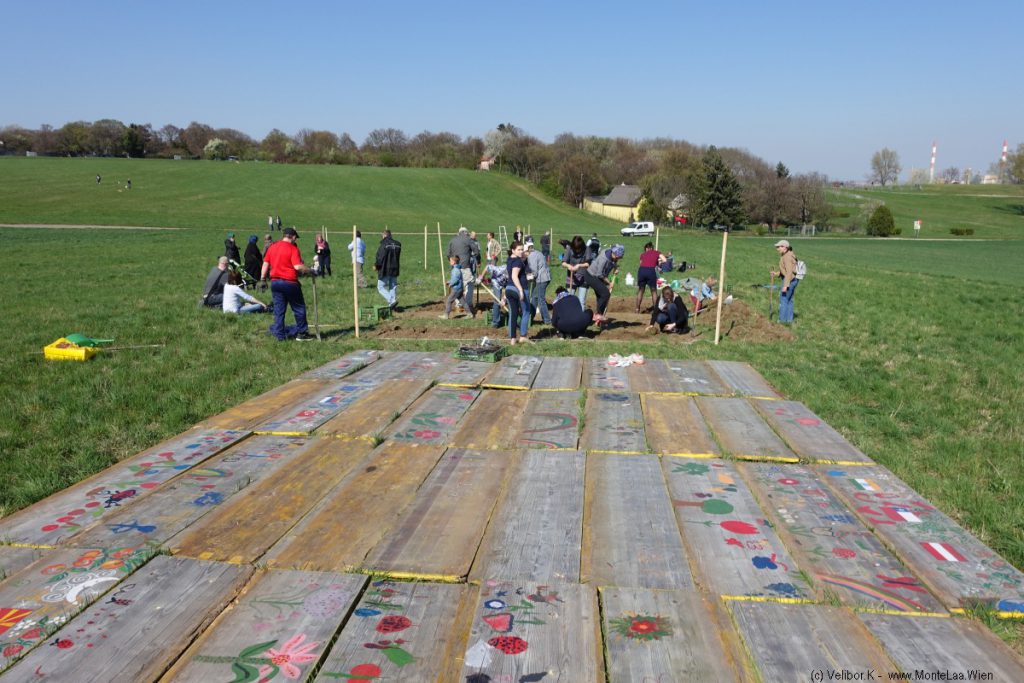
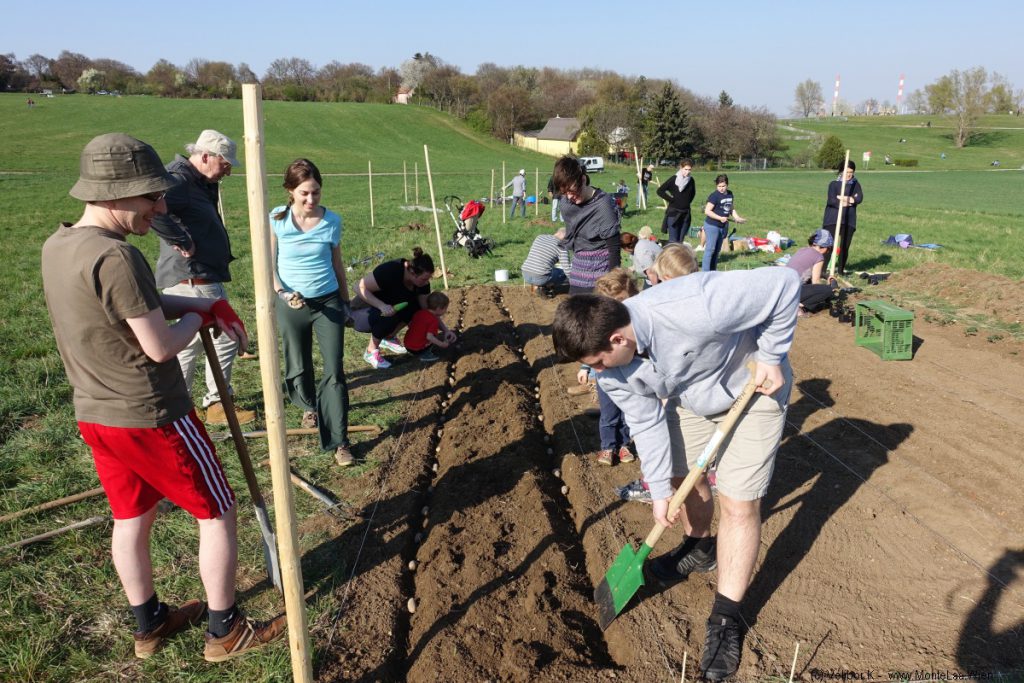
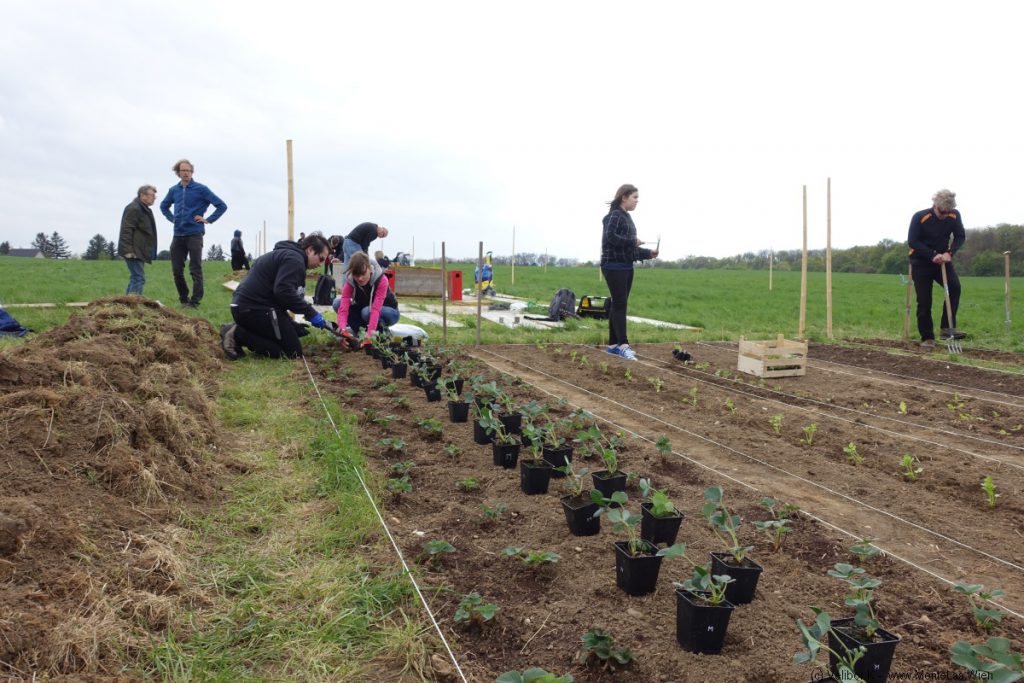
How is a CMA set up?
A group of interested individuals – usually drawn from all walks of life, comprising multicultural and environmentally conscious people, or those who, for a variety of reasons (including financial ones), wish to produce high-quality vegetables for their own consumption – form an association and lease land. (Usually within the city limits.) The investment costs and running costs are covered by membership fees and/or grants. The association draws up an annual cultivation plan by mutual agreement and grows fruit and vegetables collectively. This means that, unlike in ‘community gardens’, the land is not divided into plots for individual members; instead, each type of vegetable is grown only once, and collectively. As a result, a CMA, unlike ‘community gardens’, functions more like a farm (no fencing, large vegetable plots, no huts) and is, in fact, a farm. Most CMAs have a farm registration number with the Chamber of Agriculture, which no other community garden has.


What are 10 good reasons to run a ‘Community-Managed Farm’?
- To eat healthy, fresh, regional organic vegetables, knowing exactly how they were grown.
- To do this as a community, sharing the work with people who share similar interests.
- To learn a great deal in the process about food and how it is produced, but also about people and cultures.
- To pay far less for top quality that far exceeds organic standards, whilst investing your time in the process.
- To make an ecological contribution through sustainably managed, diverse organic farming.
- To make a political contribution through meaningful participation in shaping and taking responsibility for a piece of land.
- To create a beautiful place together that is there for everyone and is good for the soul.
- To engage in healthy physical activity that makes sense… as opposed to going to the gym.
- To build a network of people through which you discover new things and are often supported.
- To have a place and an activity that is interesting for the whole family. Children settle into it easily.

There is really only one concern: that we don’t trust ourselves or the community to coordinate and work together effectively enough to ensure everything succeeds. But, on closer inspection, this is precisely our task as human beings: to learn to do this together in peace and respect, and as equals, in our increasingly globalised world. So: take heart… and may the endeavour be a success.